
In plain language
What is robotic-assisted knee replacement?
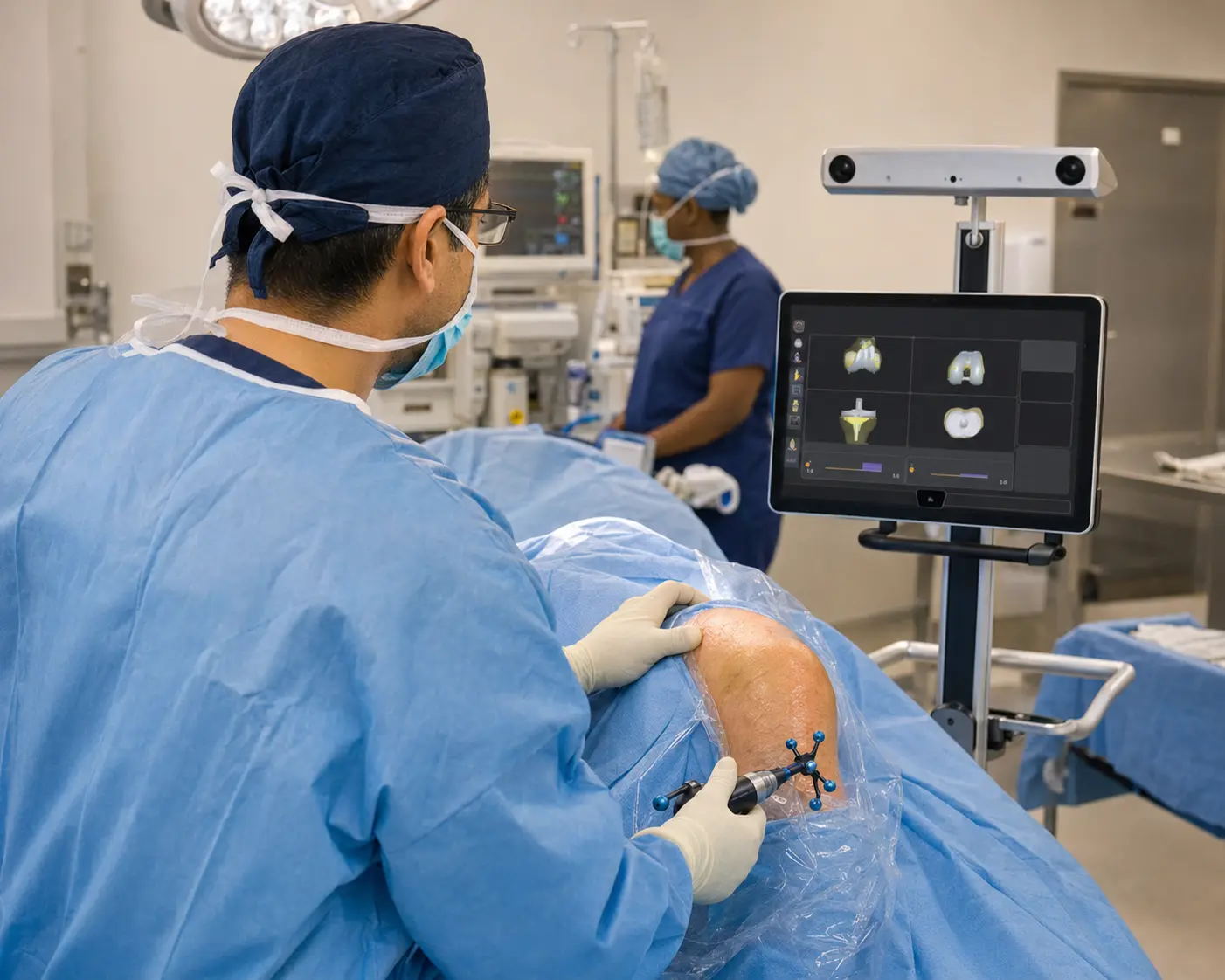
Robotic assistance is a planning and precision tool used by the surgeon during knee replacement. The surgeon performs the operation and remains in control. The system helps map the knee, measure alignment and ligament balance, and prepare bone within the surgical plan; it does not independently operate or guarantee a particular recovery.Who it may help
When might it be considered?
- Patients who already have a sound clinical indication for partial or total knee replacement
- Patients whose anatomy or deformity benefits from detailed intra-operative measurements
- People seeking an individualised discussion of conventional and robotic-assisted techniques
Before surgery
What may be considered first?
- Conventional total knee replacement using measured surgical guides
- Nonsurgical arthritis care when replacement is not yet appropriate
- Partial knee replacement in selected single-compartment disease
- Other computer-assisted techniques where clinically suitable
Inside the operating theatre
What actually happens during the operation?
The indication comes first
Robotic technology is not a reason to replace a knee. Symptoms, examination, standing X-rays and failed nonsurgical care must first show that replacement is appropriate.
Mapping your knee
Trackers allow the system to understand the knee’s position in space. The surgeon records anatomical landmarks and movement so a patient-specific digital model can be created during the operation.
Testing the plan
The surgeon measures deformity, alignment and ligament tension through the range of motion. Implant size and position can be adjusted virtually before bone preparation begins.
Surgeon-controlled bone preparation
The surgeon guides the robotic-assisted instrument within planned boundaries. The system supports precision, while exposure, ligament decisions, implant choice and every safety judgement remain the surgeon’s responsibility.
Verification
Trial and final components are assessed for alignment, balance, stability and movement. The operation then proceeds through the same wound closure and recovery principles as other knee replacements.
After the operation
What does recovery involve?
Patients still experience surgical pain, swelling and temporary weakness.
Early walking and progressive exercises remain essential.
Accurate planning may support the surgical objective, but recovery varies with pre-operative stiffness, health, strength, pain sensitivity and rehabilitation.
Informed consent
Important risks to understand
- The established risks of knee replacement still apply
- Small tracker-pin sites and rare pin-related complications
- Technology or workflow may need to be converted to a conventional technique
- No robotic system can guarantee a painless, faster or complication-free result
This is a general guide, not a complete consent discussion. Your surgeon will explain risks specific to your diagnosis, health, anatomy and proposed technique.
Common patient questions
Questions people often ask
Does the robot perform the operation?+
No. The surgeon plans and performs the procedure. The system provides measurements and controlled assistance but cannot make independent clinical decisions.
Is robotic surgery automatically better for everyone?+
No. It is one surgical tool. Diagnosis, surgeon judgement, implant choice, preparation, infection prevention and rehabilitation all remain important.
Is the implant different?+
Robotic assistance usually changes how the implant position is planned and the bone is prepared, rather than changing the basic metal-and-plastic replacement concept.
Clinical references
These independent patient resources informed the general explanation above.