In plain language
What is tlif lumbar fusion?
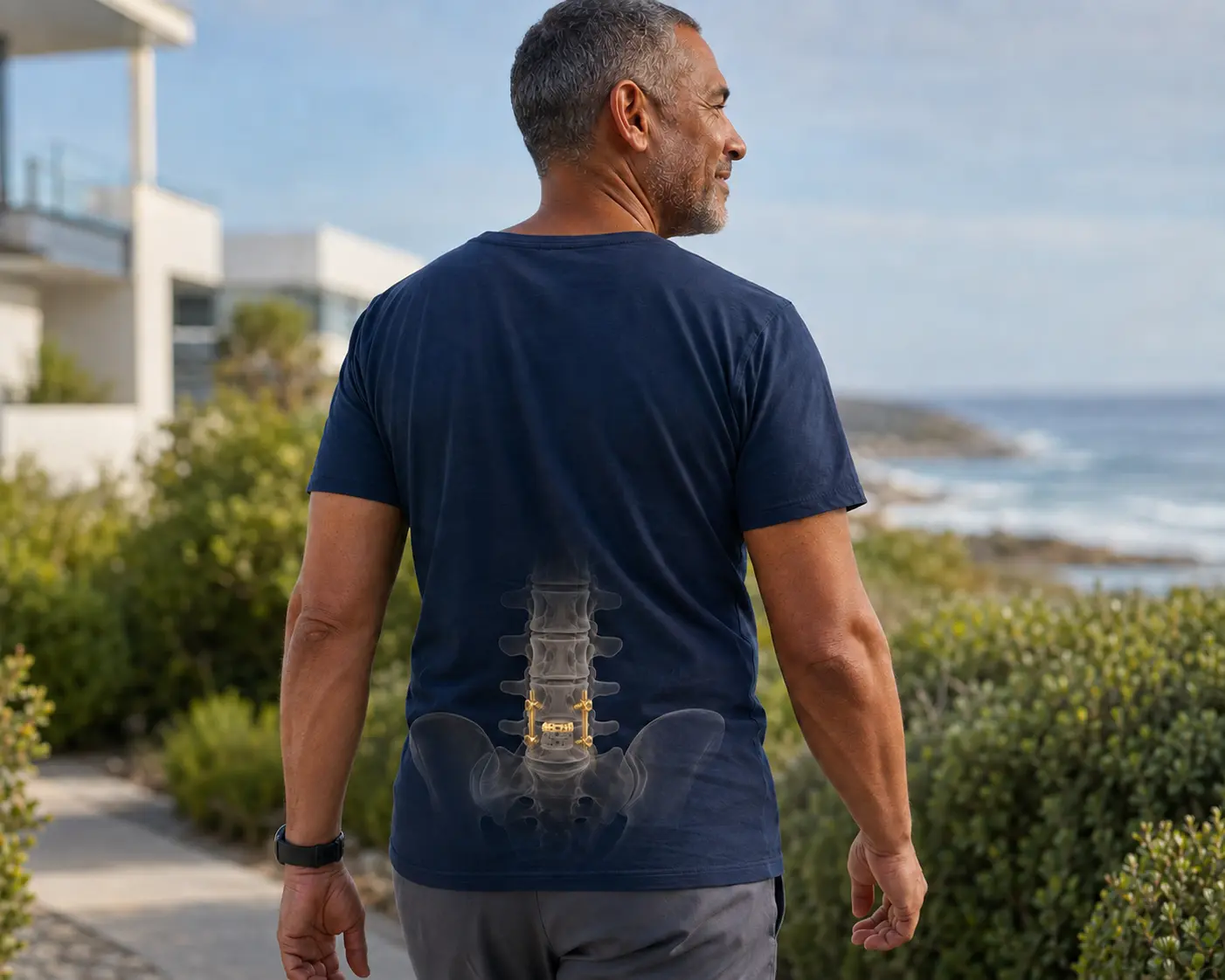
TLIF stands for transforaminal lumbar interbody fusion. The surgeon approaches the lower spine from the back, relieves pressure on selected nerves, removes the damaged disc from one side, places a spacer or cage with bone-graft material between the vertebrae, and uses screws and rods to hold the level stable while bone gradually fuses across it.Who it may help
When might it be considered?
- Painful lumbar instability or spondylolisthesis that matches symptoms and imaging
- Nerve compression requiring decompression where removing bone could leave the segment unstable
- Selected recurrent disc, foraminal narrowing or disc-collapse problems
- Symptoms that remain substantially limiting despite appropriate nonsurgical care
Before surgery
What may be considered first?
- Medication, activity modification and targeted rehabilitation
- Selected injections or nerve-root procedures
- Decompression without fusion where the segment is stable
- Continued observation when symptoms and neurological findings allow
Inside the operating theatre
What actually happens during the operation?
Positioning and imaging
The patient lies face-down under general anaesthesia. Imaging helps confirm the exact level and guides safe placement of implants.
Decompressing the nerves
Through a posterior incision, the surgeon removes selected bone and ligament to create space for the affected nerve root. The amount of decompression depends on the pathology.
Removing the damaged disc
The disc space is reached from one side of the spinal canal. Disc material is removed and the bony endplates are carefully prepared without unnecessarily weakening them.
Placing graft and cage
Bone-graft material and an interbody cage are placed between the vertebral bodies to restore support and create an environment for fusion. The cage supports the space; the long-term goal is living bone bridging the level.
Screws and rods
Pedicle screws are inserted into the vertebrae above and below and connected with rods. They provide immediate internal stability while fusion develops over months.
After the operation
What does recovery involve?
Early recovery focuses on wound care, safe walking and avoiding loads or movements that could stress the construct.
Nerve pain may improve quickly, slowly or fluctuate while an irritated nerve recovers. Numbness and weakness can take longer and may not recover completely.
Fusion is a biological process measured over months. Smoking, poor diabetic control, osteoporosis and excessive early loading can reduce the chance of solid union.
Informed consent
Important risks to understand
- Infection or wound problems
- Bleeding
- Nerve injury or dural tear
- Persistent or recurrent symptoms
- Cage or implant movement
- Failure of fusion
- Adjacent-level wear
- Need for further surgery
This is a general guide, not a complete consent discussion. Your surgeon will explain risks specific to your diagnosis, health, anatomy and proposed technique.
Common patient questions
Questions people often ask
Do the screws mean the spine is fused immediately?+
No. Screws and rods hold the segment stable immediately, but true fusion requires new bone to grow across the level over time.
Will TLIF remove all back pain?+
No operation can promise this. TLIF is most useful when a clearly identified unstable or compressed level explains the symptoms. Other pain sources may remain.
Is movement lost?+
Movement is intentionally removed at the fused level. The overall effect depends on how many levels are fused and the health of the remaining spine.
Clinical references
These independent patient resources informed the general explanation above.