In plain language
What is posterior lumbar fusion?
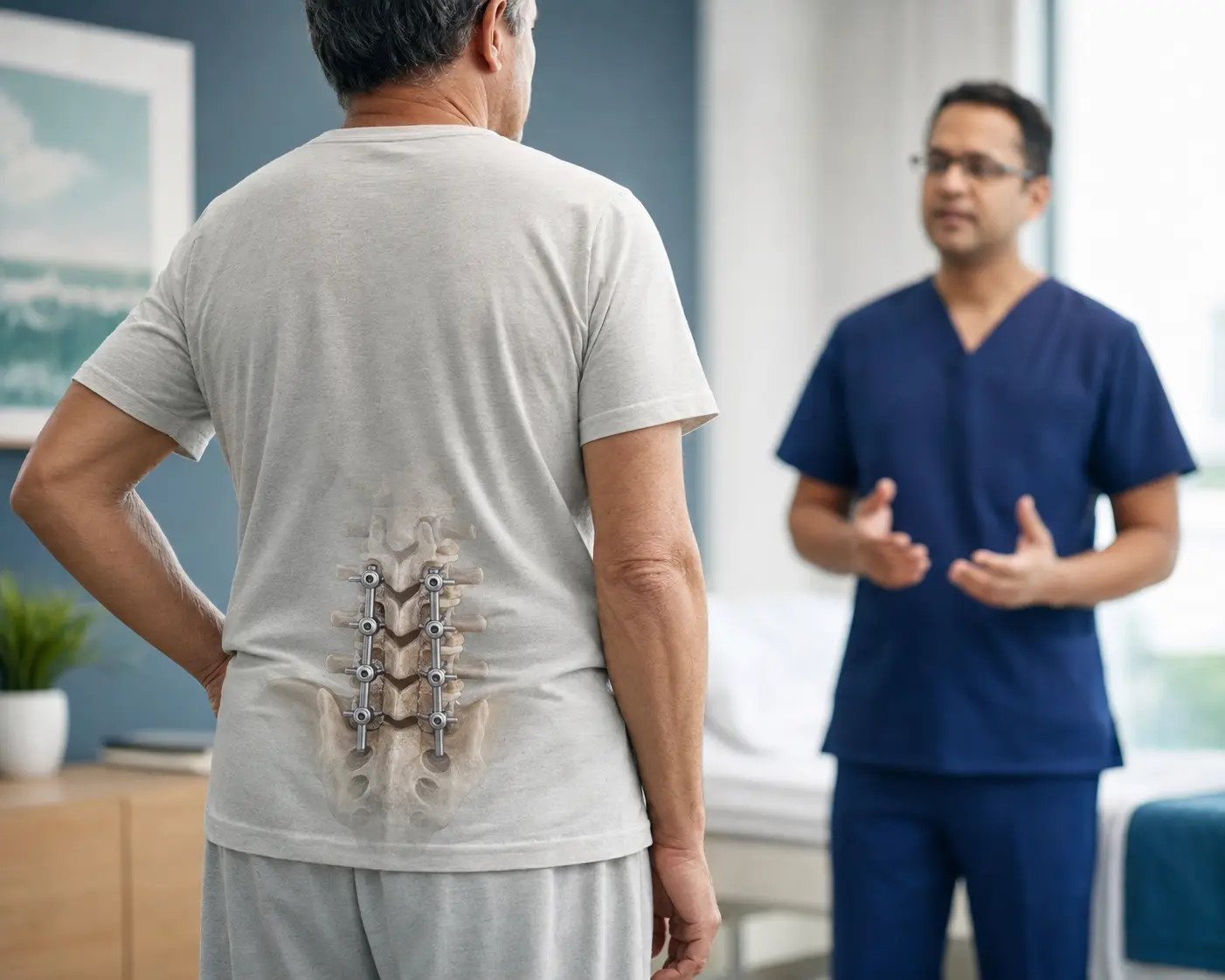
Posterior lumbar fusion stabilises one or more painful or unstable levels from the back of the spine. Pedicle screws are placed into the vertebrae and joined by rods. Bone graft is laid along prepared bone surfaces so living bone can gradually bridge the level. Unlike TLIF, a straightforward posterolateral fusion does not necessarily remove the disc or place a cage between the vertebral bodies.Who it may help
When might it be considered?
- Symptomatic lumbar instability or spondylolisthesis that matches examination and imaging
- Selected spinal deformity or painful movement between vertebrae
- A decompression that would otherwise leave the segment unstable
- Selected fractures, revision procedures or failure of a previous fusion
Before surgery
What may be considered first?
- Medication, activity modification and structured rehabilitation
- Image-guided injections when the likely pain source is suitable
- Decompression without fusion when stability can be preserved
- Continued observation when symptoms and neurological findings allow
Inside the operating theatre
What actually happens during the operation?
Confirming the level
The patient lies face-down under general anaesthesia. Imaging confirms the exact vertebrae and helps guide safe implant placement.
Decompression when required
If nerves are compressed, selected bone and ligament may be removed to create space. Fusion may be added when the spine is already unstable or the necessary decompression would reduce stability.
Screws and rods
Pedicle screws are placed into the vertebrae above and below the affected level and joined with rods. These implants hold the segment steady while bone heals.
Preparing the fusion bed
The outer bone surfaces are gently prepared and bone graft is placed along the back and sides of the spine. This graft is the biological foundation for a solid fusion.
Closure and healing
The wound is closed after alignment and implant position are checked. Hardware provides immediate support, but a true fusion develops gradually over many months.
After the operation
What does recovery involve?
Early recovery centres on wound care, regular walking and avoiding excessive bending, twisting or lifting.
Back-muscle discomfort is expected after a posterior approach. Nerve symptoms may settle quickly, slowly or fluctuate during recovery.
Fusion is a biological process. Smoking, uncontrolled diabetes, poor bone quality and excessive early loading can reduce the chance of solid union.
Informed consent
Important risks to understand
- Infection or wound problems
- Bleeding
- Nerve injury or dural tear
- Persistent pain
- Implant loosening or breakage
- Failure of fusion
- Adjacent-level wear
- Further surgery
This is a general guide, not a complete consent discussion. Your surgeon will explain risks specific to your diagnosis, health, anatomy and proposed technique.
Common patient questions
Questions people often ask
Is posterior fusion the same as TLIF?+
Not exactly. Both may use pedicle screws and rods, but TLIF also enters the disc space from behind and places an interbody cage. A posterolateral fusion may leave the disc space untouched.
Do the screws fuse the spine?+
The screws and rods stabilise the level. Fusion occurs when new living bone grows through the graft and bridges the vertebrae.
Will all back pain disappear?+
No procedure can promise that. Fusion is most useful when a clearly identified unstable or painful level explains the symptoms; other pain sources may remain.
Clinical references
These independent patient resources informed the general explanation above.