
PRP Injections for Sports Injuries and Osteoarthritis: What Does the Evidence Show?
A balanced guide to platelet-rich plasma injections for knee and shoulder arthritis, tendon and sports injuries: patient selection, evidence, limitations and alternatives.
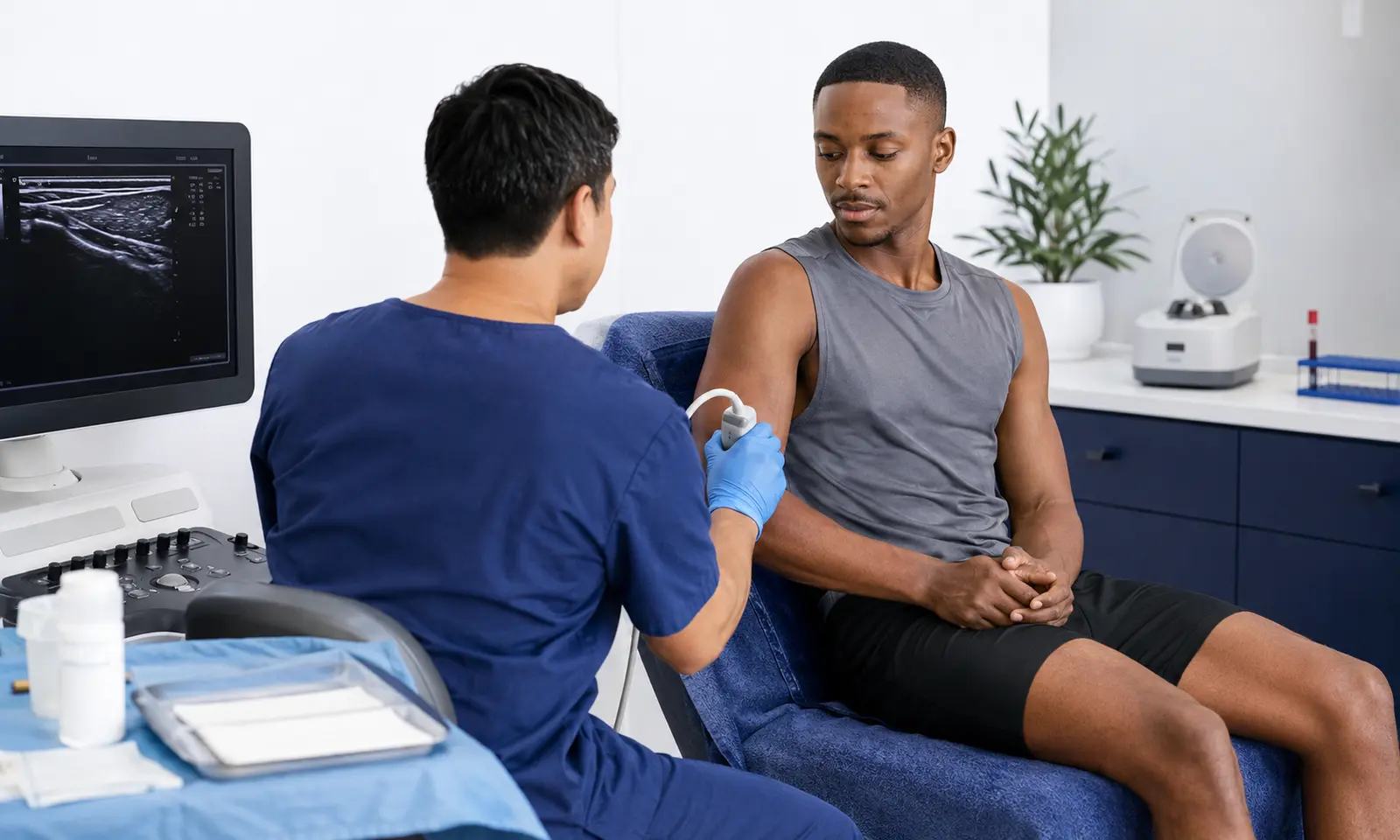
What is PRP?
PRP stands for platelet-rich plasma. A small sample of the patient’s blood is collected and placed in a centrifuge, which separates and concentrates the platelets within part of the plasma. That preparation is then injected into the carefully identified area of injury, often with ultrasound guidance.
Platelets are best known for helping blood to clot, but they also release signalling proteins and growth factors involved in the body’s response to tissue injury. PRP aims to place a concentrated mixture of these naturally occurring components at the injured site. It is an autologous treatment, meaning that it comes from the patient rather than from a donor or a manufactured steroid medicine.
Why consider PRP instead of steroid?
A corticosteroid injection is a strong anti-inflammatory treatment. It can provide useful short-term relief for some conditions, but chronic tendinopathy is often a problem of disordered tendon structure and load tolerance rather than simple inflammation. Repeated steroid exposure around certain tendons may weaken tissue, and steroid injection directly into the Achilles tendon is generally avoided because of concern about rupture.
PRP is therefore sometimes discussed when an injection is being considered but steroid is not appropriate or its short-lived benefit is unlikely to address the treatment goal. This does not mean that PRP is automatically better. The diagnosis, exact tissue involved, duration of symptoms, previous rehabilitation and quality of the evidence for that particular condition all matter.
Which sports injuries may respond?
The most encouraging clinical evidence is in selected chronic tendon disorders. Tennis elbow—lateral elbow tendinopathy—is one of the more frequently studied examples. Some trials and reviews report better medium- or longer-term results with PRP than with corticosteroid, although comparisons with placebo have been less consistently positive.
PRP is also being studied for patellar tendinopathy, plantar fascia pain, selected rotator-cuff problems and partial ligament injuries. These are not interchangeable conditions, and a positive study in one tendon cannot be assumed to apply to another. For chronic mid-portion Achilles tendinopathy, good placebo-controlled trials and a recent review have not shown a meaningful advantage, so PRP should not be promoted as reliably effective for that diagnosis.
Evidence for acute muscle injuries such as hamstring strains is mixed. Some newer studies are encouraging, while well-designed trials have found no faster return to play than high-quality rehabilitation alone. At present, PRP is best viewed as a selective option after a precise diagnosis—not as a shortcut back to sport.
- Most plausible role: selected chronic tendinopathy that has not improved with an appropriate loading programme
- Possible role: certain partial tendon or ligament injuries after specialist assessment
- Uncertain role: acute muscle strains and many postoperative applications
- Poorly supported approach: using PRP for every painful area without a clear diagnosis
The scientific basis is growing—and still evolving
PRP is not one standardised product. Preparation systems produce different platelet concentrations, white-cell content, plasma volume and activation methods. Injection technique, number of injections and the rehabilitation programme also vary. This biological and procedural variation helps explain why studies sometimes reach different conclusions.
The field is moving beyond asking whether ‘PRP works’ towards more useful questions: which formulation, for which tissue, at what stage of injury, delivered in what way, and alongside which rehabilitation plan? That is a genuine and growing scientific basis, but it also means confident universal claims are premature.
PRP for knee osteoarthritis
Knee osteoarthritis is the most extensively studied joint application of PRP. Multiple trials and reviews show that some patients experience clinically useful improvements in pain and function, often becoming most apparent over the first three to six months and sometimes continuing for 12 months. On average, several analyses have found PRP to perform better than hyaluronic acid, although not every placebo-controlled study has shown an important benefit.
Patient selection matters. Recent European consensus considers PRP appropriate mainly for symptomatic early-to-moderate knee osteoarthritis—Kellgren–Lawrence grades 0 to III—after reasonable nonsurgical treatment has not provided enough relief. It is not considered an appropriate first treatment or a reliable option for grade IV, bone-on-bone arthritis. A patient with major deformity, severe stiffness or pain that substantially limits everyday life is less likely to obtain a durable result from another injection.
PRP is a symptom-modifying treatment, not a cartilage-regrowing treatment. Improvement in pain and function should not be presented as proof that the joint surface has regenerated or that arthritis progression has stopped. Exercise, strength, weight optimisation where relevant and activity planning remain important, even when an injection helps.
- More suitable: mild-to-moderate knee arthritis with persistent symptoms despite appropriate nonsurgical care
- Less predictable: advanced joint-space loss, marked bow-leg or knock-knee deformity, severe stiffness or major functional loss
- Expected goal: a worthwhile period of reduced pain and improved function—not a permanent cure
- Reassessment is important: a hot, very swollen or rapidly worsening knee requires a diagnosis before any PRP injection
Where PRP may fit in shoulder treatment
The shoulder requires an especially precise diagnosis because pain may arise from the glenohumeral joint, acromioclavicular joint, rotator cuff, biceps tendon, bursa, neck or a combination of these structures. The injection target and the evidence are therefore different for arthritis inside the joint and disease within a tendon.
For glenohumeral osteoarthritis, the evidence is smaller than it is for the knee. In a randomised trial, a single ultrasound-guided leukocyte-poor PRP injection and a hyaluronic-acid injection both produced improvements in pain and function for up to 12 months, but PRP was not superior to hyaluronic acid. This supports PRP as a possible alternative for selected patients, while also showing why it should not be described as proven cartilage restoration or as the best injection for every arthritic shoulder.
For rotator-cuff tendinopathy and partial tears, studies remain inconsistent. Some trials and reviews report short-term improvement, while the 2025 AAOS guideline does not support routine PRP injection for every rotator-cuff tendinopathy or partial tear. In practice, PRP may still be discussed selectively after examination and imaging, particularly when a structured rehabilitation programme has not been sufficient and repeated steroid injections are undesirable. It should not be expected to reconnect a full-thickness or retracted tendon tear.
Ultrasound guidance is particularly useful in the shoulder because it confirms that the injection reaches the intended joint, bursa or tendon region. The response should be assessed against a defined goal such as improved sleep, movement, strength progression or participation in rehabilitation.
How PRP differs from steroid and hyaluronic acid
These injections are not interchangeable. Corticosteroid is primarily a potent anti-inflammatory treatment and may provide quicker short-term relief when inflammation or synovitis is a major component. PRP generally acts more slowly and is considered when the goal is a longer symptom response or when repeated steroid exposure around a tendon is undesirable. PRP does not cause the same temporary rise in blood glucose associated with steroid, although the patient’s full medical history still needs review.
Hyaluronic acid is intended to supplement the lubricating properties of joint fluid and is used mainly in knee arthritis. Evidence for its average benefit is modest. PRP has outperformed hyaluronic acid in several knee-arthritis analyses, but the comparison is less clear in the shoulder. Cost, availability, preparation method, previous response and the strength of evidence for the exact joint should all be discussed.
None of these injections corrects major deformity, removes a mechanical block, repairs an unstable joint or replaces indicated surgery. An injection should have a specific purpose and a plan for what happens next.
Inflammatory joint conditions are different
Osteoarthritis can include local inflammatory activity, but it is not the same disease process as rheumatoid arthritis, psoriatic arthritis or another systemic inflammatory arthritis. Laboratory studies suggest that PRP can influence inflammatory signalling, yet clinical evidence in autoimmune inflammatory joint disease remains limited to small studies and early research.
PRP should therefore not be promoted as a treatment for the underlying autoimmune disease. It does not replace disease-modifying antirheumatic medication, rheumatology follow-up or appropriate treatment of active synovitis. In a patient whose inflammatory arthritis is well controlled but who also has secondary osteoarthritis in one joint, PRP might occasionally be considered for the osteoarthritic symptoms after discussion with the treating team.
A red, hot or markedly swollen joint must be assessed before injection. Infection and crystal arthritis such as gout need to be excluded where clinically relevant; injecting PRP into an undiagnosed acute joint flare is not an appropriate substitute for establishing the cause.
PRP should accompany rehabilitation, not replace it
For most sports-related tendon problems, progressive loading remains the foundation of treatment. The aim is to restore the tissue’s ability to tolerate the forces required for work, exercise and sport. An injection cannot correct poor movement control, inadequate strength, training errors or an unrealistic return-to-play schedule.
If PRP is chosen, it should create an opportunity to progress a structured rehabilitation plan. Patients are usually advised to reduce heavy activity for a short period and then rebuild load gradually. Improvement, when it occurs, may take several weeks or months rather than being immediate.
What are the limitations and risks?
Because PRP is prepared from the patient’s own blood, allergy is uncommon. Temporary pain, swelling, stiffness and bruising around the injection are more frequent. Infection, bleeding and injury to a nearby structure are uncommon but possible with any injection. An ultrasound-guided technique may improve accuracy where the target is small or close to important structures.
PRP may be unsuitable or require additional planning in people with certain blood or platelet disorders, active infection, significant anaemia, some cancers, or medicines that affect bleeding and platelet function. These factors should be reviewed individually. Patients should also understand the cost and the possibility of no meaningful improvement before proceeding.
A sensible decision framework
The decision should begin with the diagnosis rather than with the injection. A clinical assessment—and imaging where it is likely to change management—helps distinguish tendinopathy from a full-thickness tear, joint disease, nerve pain or another problem that requires a different treatment.
- Confirm the injured structure and severity
- Review whether rehabilitation has been specific, progressive and long enough
- Explain why steroid is unsuitable or unlikely to meet the treatment goal
- Discuss the evidence for that exact condition, not PRP in general
- Agree on the post-injection rehabilitation and return-to-sport plan
- Set a review point and a plan if PRP does not help
Common questions
Questions patients often ask.
Is PRP a stem-cell treatment?
No. PRP is a concentrated blood product containing platelets and plasma. It does not contain therapeutic stem cells and should not be described as stem-cell therapy.
Is PRP better than a cortisone injection?
It depends on the diagnosis and the treatment goal. Steroid may provide faster short-term relief in some inflammatory conditions, while PRP may be considered for selected chronic tendon problems where steroid is undesirable. PRP has shown better medium-term results than steroid in some studies, but it has not consistently beaten placebo across all conditions.
How quickly does PRP work?
PRP is not an immediate painkiller. Symptoms may temporarily flare after injection, and any benefit usually develops gradually over several weeks. Rehabilitation remains important during recovery.
How many PRP injections are needed?
There is no universal number. Research protocols range from one injection to a short series, and the best schedule is not established for every condition. More injections should not be assumed to produce a better result.
Can PRP heal a completely torn tendon or ligament?
PRP should not be assumed to reconnect a complete tear. Some complete or significantly retracted injuries require surgical assessment, while others may be treated without surgery. The structural injury and functional demands must be assessed first.
Can PRP regrow knee or shoulder cartilage?
No convincing clinical evidence shows that a PRP injection regrows lost cartilage or reverses established osteoarthritis. It may reduce pain and improve function in selected patients, but this is symptom improvement rather than proven joint-surface regeneration.
Who is most likely to benefit from PRP for knee arthritis?
The evidence is most favourable for symptomatic mild-to-moderate knee osteoarthritis after appropriate exercise, weight management and medication have not provided enough relief. Results are less predictable with bone-on-bone arthritis, major deformity or severe stiffness.
Can PRP be used for shoulder arthritis?
It may be considered for selected glenohumeral osteoarthritis. A randomised trial found improvement after both PRP and hyaluronic acid but no clear superiority of PRP. Accurate diagnosis and image-guided placement are important because shoulder pain can arise from several different structures.
Can PRP treat rheumatoid or psoriatic arthritis?
PRP is not an established treatment for systemic inflammatory arthritis and must not replace rheumatology care or disease-modifying medication. Its role in these conditions remains experimental. A patient with controlled inflammatory arthritis and separate osteoarthritis requires an individual joint assessment.
Can I return to sport immediately after PRP?
Usually not. A brief period of activity modification is commonly followed by progressive loading and sport-specific rehabilitation. Return should be based on pain, strength, function and the underlying injury rather than the injection date alone.
Sources and further reading
This guide is general educational information, not a diagnosis or personal medical advice. Treatment decisions require an individual assessment.
- AAOS OrthoInfo: Platelet-Rich Plasma (PRP)
- AAOS OrthoInfo: Orthobiologics FAQ
- 2024 ESSKA-ORBIT consensus: PRP for knee osteoarthritis
- ESSKA-ICRS consensus: Appropriate use of PRP for knee osteoarthritis
- 2025 meta-analysis: PRP for knee osteoarthritis
- Randomised trial: PRP versus hyaluronic acid for shoulder osteoarthritis
- AAOS 2025 guideline: Management of rotator-cuff injuries
- 2024 review: PRP and other blood-derived orthobiologics for shoulder disorders
- 2024 review: PRP in rheumatic diseases
- 2025 systematic review: PRP for pain in sports injuries
- 2024 meta-analysis: PRP versus corticosteroid for lateral epicondylitis
- JAMA randomised trial: PRP for chronic Achilles tendinopathy
- 2025 systematic review: PRP for Achilles tendinopathy
- Randomised trial: PRP and return to play after hamstring injury
- Lancet review: Corticosteroid injections for tendinopathy